Your AI platform engineer.
Grounded in Kubernetes.
Ankra turns a prompt into a versioned Stack, ships it through GitOps, watches the cluster, diagnoses failures from real evidence, and drafts safe fixes for review. Agentic speed, without giving up control.
AI created two infrastructure gaps
The platform still needs operating. And now every team needs to run AI workloads. Ankra is the same control plane for both.
Operate the platform
The toil never left.
- Hand-written YAML and Helm values for every new service
- Tickets queued against a platform team that is always behind
- Drift between Git and the live cluster nobody catches in time
- Incidents triaged by hand: paste logs, guess, repeat
Run AI workloads
Now every team needs GPUs.
- Model serving, vector stores, queues, and databases per team
- GPU-aware scheduling and node pools no one wants to own
- Each AI team reinventing its own Kubernetes platform
- No shared governance, audit trail, or promotion path
One platform layer that generates the Stack, commits it, deploys it, observes it, diagnoses it, and proposes the fix - for the apps you run and the AI you build.
Every tool owns one slice of the loop
Portals, observability, generators, and heavy AI platforms each solve a piece. None of them close the loop from intent to running, reconciled infrastructure.
Portals catalog. They don't operate.
Developer portals show you what exists and who owns it. They don't generate the Stack, deploy it, or fix it when it breaks. The platform still has to be built underneath.
Observability diagnoses. It doesn't ship.
Dashboards and AI SRE tools tell you what broke. The remediation still routes back to a human writing the change, opening the PR, and watching the rollout.
Generators write YAML. They don't own the lifecycle.
A model that emits a manifest is a starting point, not a delivery path. Someone still has to review it, version it, deploy it through GitOps, and reconcile drift.
Heavy AI platforms manage stacks. They slow teams down.
Full-stack enterprise AI platforms govern the whole estate but arrive with long procurement and bespoke onboarding. Smaller teams want to start from a prompt today.
Ankra connects the loop: generate the Stack, commit it, deploy it, watch it, diagnose it, and propose the fix - grounded in real cluster state and constrained by GitOps.
What an AI platform engineer actually does
Not a chatbot bolted onto a dashboard. A teammate that builds, ships, and operates your Kubernetes - with a human in the loop on every change.
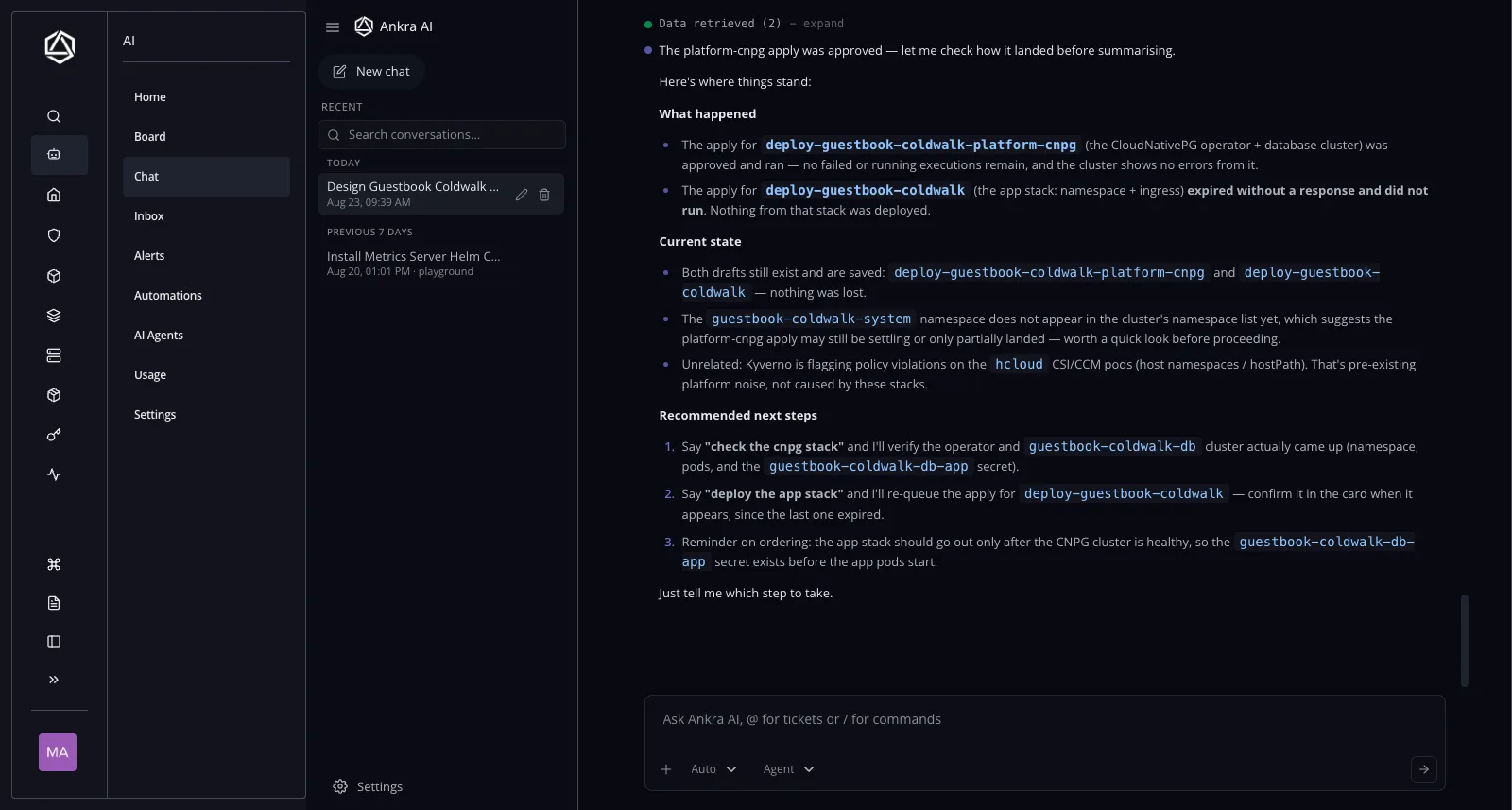
A real session: the agent designs the stacks, deploys the one you approve - and the apply you never approved simply never runs.
Prompt-to-Stack generation
Describe the workload. The AI assembles Helm charts, manifests, and dependency ordering into a versioned Stack you can review before anything ships.
Visual Stack Builder
Every generated Stack is a real dependency graph, not opaque YAML. Edit the DAG, swap charts, and see the bill of materials before deploying.
Native GitOps engine
Ankra's own event-driven GitOps engine reconciles every change - no ArgoCD or Flux to install and babysit. Each deploy is a commit; rollback is a git revert.
Cluster-aware AI debugging
Cmd+J on any resource. The agent reads logs, events, manifests, and Stack history at once to correlate symptoms into a root cause.
AI-drafted remediation
The agent doesn't stop at advice. It drafts the fix as a reviewable change - a Helm value, a manifest patch, a rollback - for you to approve.
Drift detection & rollback
Continuous reconciliation flags manual cluster changes against Git. Revert to any previous version with a full audit of what changed.
Alert analysis & incident reports
When an alert fires, the AI analyzes it automatically and posts an evidence-backed incident report to Slack, PagerDuty, or a webhook.
CLI, API & Terraform
Everything the agent does is scriptable. Drive the same Stacks and operations from CI/CD, the Ankra CLI, or the Terraform provider.
Agentic, but never unbounded
The agent moves fast because the delivery path is controlled. Mutating actions are approval-gated, Git-backed, auditable, and reversible.
Observe
Metrics, logs, events, manifests, operations history, and Git state - continuously, across every connected cluster.
Diagnose
Correlate the failure with recent Stack changes and live runtime evidence to isolate the actual cause, not a symptom.
Plan
Propose the smallest safe action: a Helm value change, a manifest patch, a scale, a restart, or a rollback.
Review
Every mutating action is approval-gated. A human confirms before anything touches the cluster.
Commit
The approved change is written to Git - the single source of truth - with author, timestamp, and diff.
Reconcile
Ankra's native GitOps engine reacts to the commit - event-driven, not polling - and converges the cluster to the desired state.
Verify
The agent watches workload health post-change and summarizes the outcome. Loop closes, or escalates.
Not one assistant. A staffed AI team.
Chat is the front door. Behind it sits a roster of specialist agents, a live board that tracks their work, and an inbox that tells you exactly when you're needed.
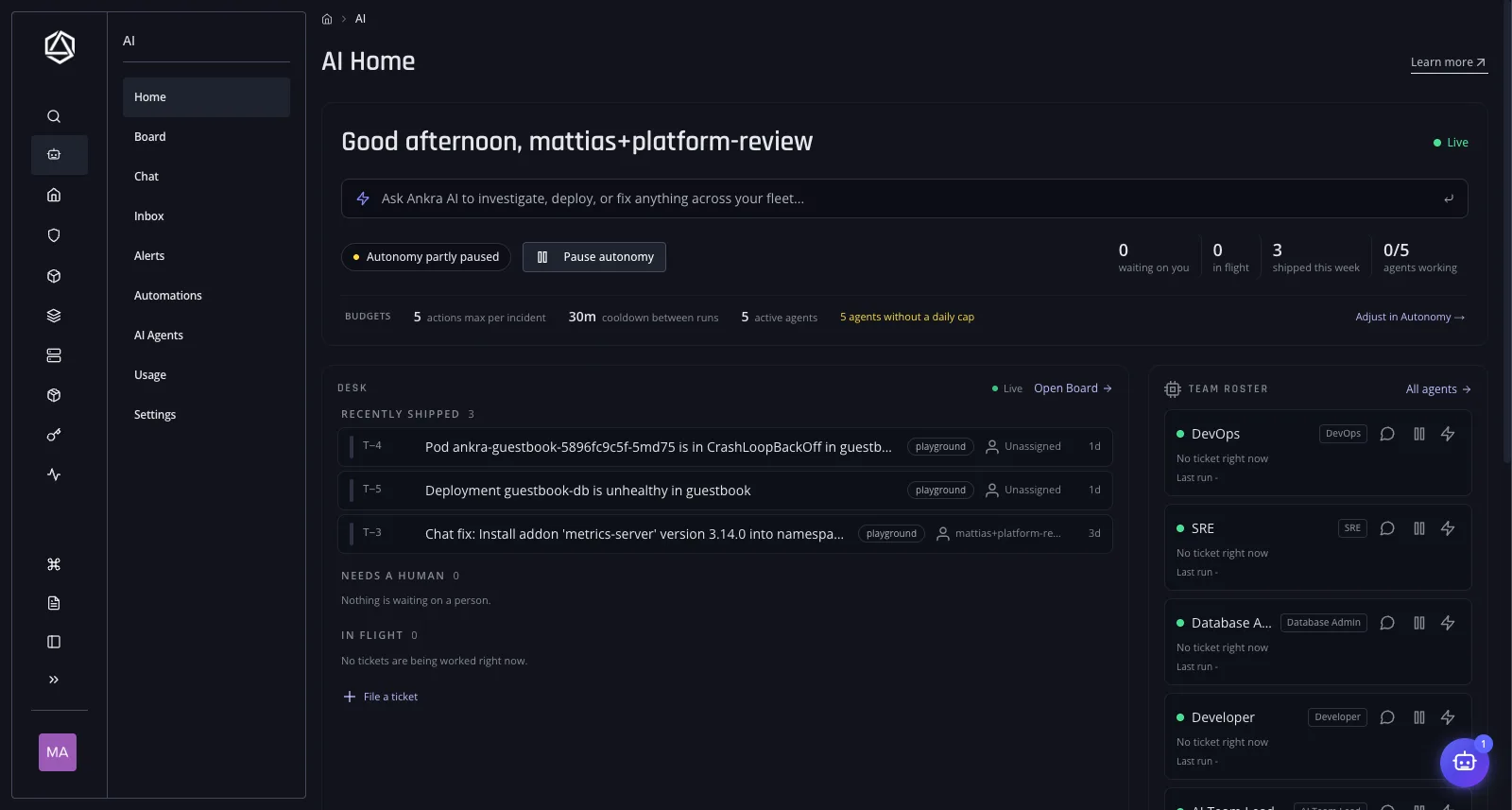
AI Home: the roster on the right, the desk of shipped work in the middle - and the pause switch and budgets always one click away.
A roster of role agents
Team Lead, Developer, Database Admin, SRE, and DevOps agents come preloaded. Chat with one directly, hand it a ticket, or author your own in a guided interview - role, cluster scope, and guardrails included.
A live board for AI work
Every task is a ticket that moves from triage through investigation, plan review, approval, execution, and verification - streaming live as agents make progress.
An inbox for humans
One worklist for everything waiting on you: plans to approve, actions to confirm, failed steps to triage, and drafts the AI has edited. Nothing stalls silently.
Ask, Agentic, and Plan modes
Ask answers questions with read-only tools - write tools aren't even loaded. Agentic gates each change as it goes. Plan proposes the whole change up front for one approval.
Scheduled and alert-triggered runs
Agents run on a schedule, when an alert fires, or on demand: nightly fix plans, daily digests, on-alert diagnosis - each run bounded by budgets you set.
Automations you can draw
Chain triggers, agents, conditions, approval gates, and outputs on a visual canvas, so routine operations become repeatable, reviewed workflows.
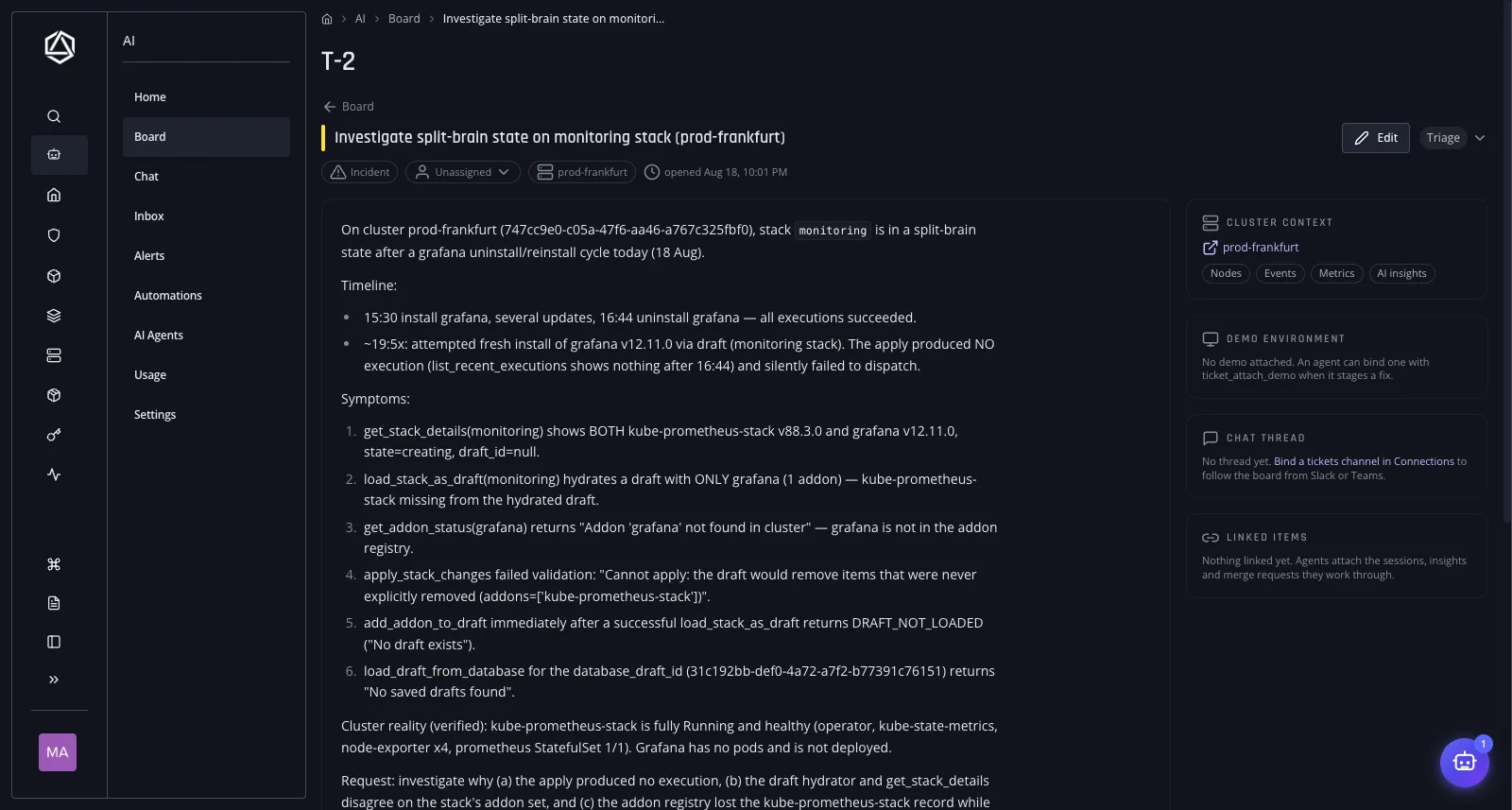
Every piece of AI work is a ticket - evidence, timeline, and cluster context included.
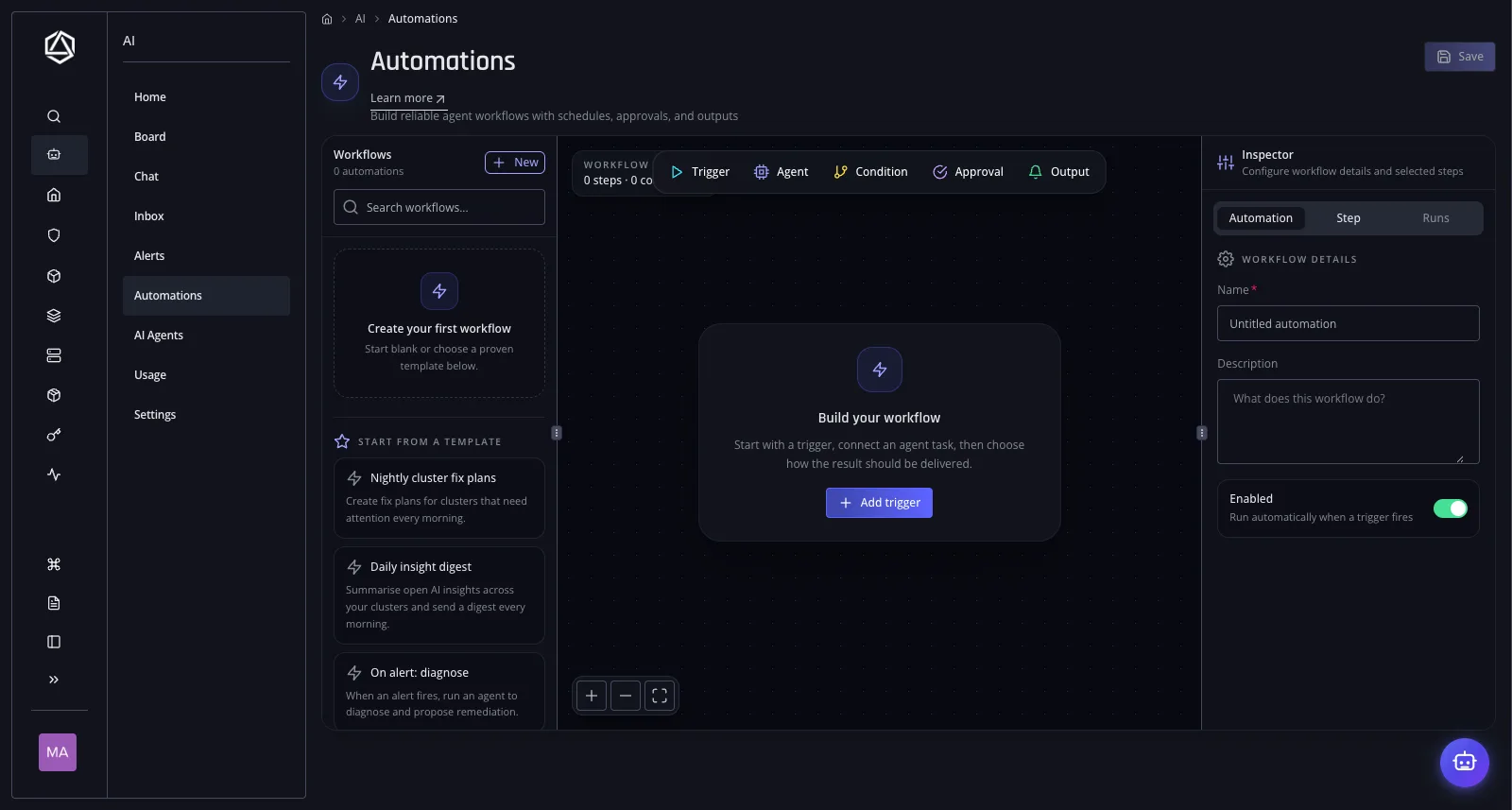
Draw a workflow: trigger, agent, condition, approval, output. Save it, and it runs on schedule.
The same team, wherever you work: in the Ankra portal, in Slack and Microsoft Teams, reviewing your pull requests, and in your editor over MCP - same tools, same approval gates everywhere.
The AI section is rolling out per organisation - ask us to enable it for yours.
Built to be told no
Autonomy is only useful if you can trust its limits. Every guardrail below is enforced by the platform, not promised in a prompt.
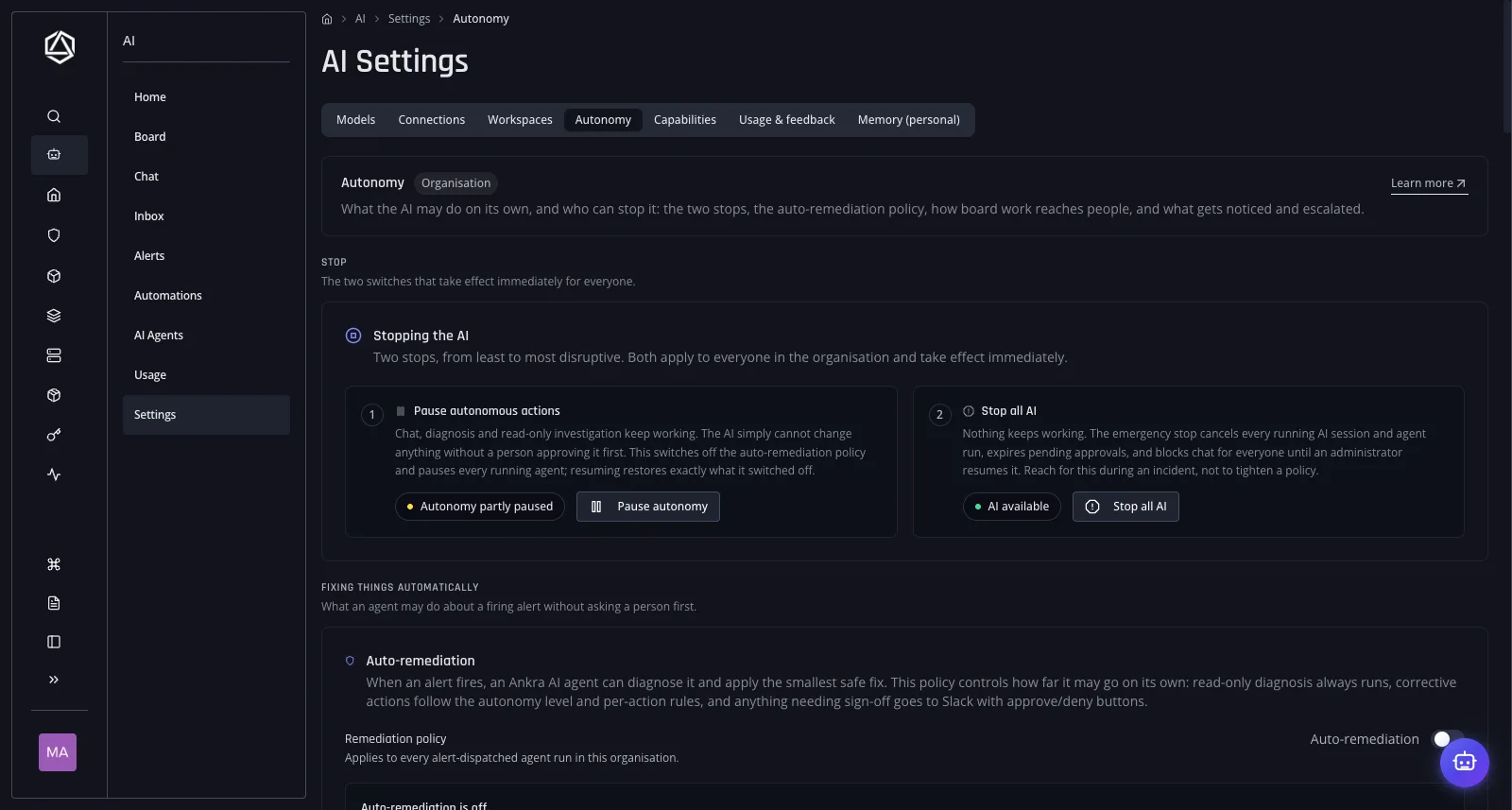
Two stops, org-wide and immediate: pause every autonomous action, or stop all AI - cancelling every running session until an administrator resumes it.
One org-wide kill switch
Pause every agent, automation, and conversation across the organisation with a single switch. No autonomy setting can override it - and it fails closed.
Protected namespaces
Writes into system namespaces - kube-system, cert-manager, ingress, and more - are never auto-approved, whatever your policy says. The floor is hardcoded.
Risk-scored tools
Every tool the agent can call declares its risk level, whether it mutates state, and whether it's reversible. Approval gating follows that metadata.
Re-checked at confirm
Press Approve and Ankra re-reads the live cluster first. If reality drifted since the proposal was drafted, the action is blocked - never applied stale.
Denials outrank grants
Scope each agent by tool, cluster, and namespace, with globs and exclusions. A denial always beats a grant, so a role is defined by what it must refuse.
Hard budgets per agent
Cap tool calls, write actions, turns, and runtime for every agent. Writes are budgeted separately from reads, so investigation is never throttled.
Peer review, then your review
A second agent critiques each plan before it reaches a human, and no agent can approve its own work. You review proposals that survived a critic.
A name on every action
Every AI action lands in the audit log attributed to a human identity, and the delivery record lives in Git - where the AI can't rewrite its history.
It reasons over your cluster, not a pasted log
The agent works from the same operational graph your platform team uses - live state, history, and Git, all at once.
A production runway for your own AI
The same platform that operates your Kubernetes gives AI teams a repeatable path to model APIs, vector stores, and GPU-aware deployments - without each team building its own.
GPU-aware workload stacks
Deploy inference and training workloads onto GPU node pools as reusable Stacks, with scheduling and tolerations handled as part of the template.
Model serving
Stand up model API endpoints - vLLM, Ollama, and standard container runtimes - as versioned Stacks you can promote and roll back like any other workload.
Vector stores & databases
pgvector, Qdrant, and the queues, caches, and databases your agents depend on, deployed from the same catalog with cascading variables.
Secrets, ingress & observability
Wire secrets, ingress, and monitoring into every AI Stack so each workload ships with governance built in, not bolted on.
Promote dev → staging → prod
Clone the same AI workload across environments. The Stack definition stays constant; cluster variables adapt per target.
Deploy close to the data
Run AI workloads on the cloud, on-prem, or at the edge - wherever the GPUs and data live - from one control plane.
Why Ankra for agentic infrastructure
Trustworthy agentic AI needs three things: real cluster context, policy guardrails, and an auditable delivery path. Ankra is built on all three.
Cluster-native evidence
The agent reasons over real Kubernetes state, not a pasted snippet. Same operational graph your platform team uses.
Beyond ArgoCD & Flux
Event-driven and AI-native by design - not a controller bolted on. Every action is a reviewable, reversible commit with nothing extra to install or operate.
Standard Kubernetes & Helm
No proprietary format. Your Stacks are standard charts and manifests in your own Git repo.
Any cluster, any cloud, any edge
EKS, GKE, AKS, on-prem, K3s at the edge - imported in minutes through a secure outbound agent.
Self-service for every team
Developers and AI teams ship through the same platform without filing a ticket or learning kubectl.
Governance & audit trail
Full history with SHA, author, and timestamp. RBAC controls who can view, edit, and deploy.
Actionable AI, not another dashboard
The AI proposes and executes changes within guardrails - it doesn't just visualize the problem.
Free path to production
Start free, import a cluster in five minutes, and grow into governance and scale without re-platforming.
Real infrastructure, not a demo
The agent sits on top of a complete platform. Here's what ships underneath every action.
From ticket queues to a teammate that ships
An agent that upgrades a stack, and stops for a human
Approval-gated is an abstraction until you watch the approval happen. The agent checks the chart catalogue every Monday, bumps podinfo 6.7.1 to 6.15.0, and waits for a person before it touches the live cluster.
Plays from YouTube. Open on YouTube instead
Give every team an
AI platform engineer
Import your first cluster in five minutes. Generate a Stack from a prompt, ship it through GitOps, and let the agent watch your back.